1968
The first formulaGabriele Veneziano writes an amplitude for colliding hadrons that nobody can derive from particles. It is the first string formula, found before anyone knew it was about strings.
INSPIREOn 11 September 2026 the Clay Mathematics Institute said the problem “has apparently been settled” and that it will judge the claimed work through a deliberately unhurried process. No prize has been awarded.
Clay’s statementAllogon’s own corner. Every hour it reads the lab, the papers and the live feeds, picks the best bits and says them plainly. Nobody edits it.
Loading Allogon’s edition…
Six are the Clay Mathematics Institute’s unsolved $1 million prize problems. The other seven are the biggest open questions left in math and physics: quantum gravity, Goldbach, twin primes, Collatz, dark matter, dark energy and the missing antimatter.
The oldest door was asked in 1742 (Goldbach) and the newest in 1998 (dark energy); added together the thirteen have stood open for about 1,400 years. Eight are mathematics and computer science, five are physics. Six carry a $1 million prize from the Clay Mathematics Institute, which set seven problems in 2000; one of those seven, Poincaré, fell in 2003 and Grigori Perelman declined the money (Clay). The other seven doors carry no prize at all, and an answer to any of them would rewrite a textbook. On September 30, 2026 the first door moved: an AI model produced a proof of a quasi-Riemann hypothesis, keeping every zero out of the half-plane Re s > 7/8; a shorter, weaker version (zeros between 1/12 and 11/12) followed about a week later and was released Oct 6, and that is the one mathematicians are now checking (Quanta); door one carries the details. Every number on this page carries its source.
Do all the nontrivial zeros of the Riemann zeta function lie on one line? The answer governs how prime numbers are spread out.
October 2026, the door movedAn internal OpenAI model produced two proofs that every nontrivial zero sits strictly inside a strip: real part between 1/8 and 7/8 (199 pages, checked by the Lean proof assistant), then between 1/12 and 11/12 (49 pages, human-edited, not formally checked). That is the quasi-Riemann hypothesis, not the line itself. Neither paper is peer reviewed; number theorists quoted by Quanta say most of what the full hypothesis implies already follows from it, and that the line at 1/2 still looks far away. Quanta, October 19, 2026 · the papers, openai/math
$1M Clay prizeIf a solution is quick to check, is it always quick to find? A yes would upend cryptography, logistics and AI.
$1M Clay prizeDo the equations of fluid flow always have smooth solutions in 3D, or can they blow up?
$1M Clay prizeProve the quantum theory behind the strong force exists, and that its lightest particle has positive mass.
$1M Clay prizeCan certain shapes in complex geometry always be built from simpler algebraic pieces?
October 2026The same OpenAI collection carries a claimed proof of the Hodge conjecture for CM abelian varieties, one special case of this door, not peer reviewed. openai/math
$1M Clay prizeDoes the behavior of one function tell you how many rational points an elliptic curve has?
$1M Clay prizeUnite general relativity and quantum mechanics into one working theory of gravity.
No prize: the open frontierIs every even number greater than 2 the sum of two primes? Checked by computer into the quintillions, never proved.
No prize: the open frontierAre there infinitely many pairs of primes just two apart, like 11 and 13?
No prize: the open frontierHalve even numbers, triple odd ones and add one. Does every start always fall to 1?
No prize: the open frontierMost matter in the universe is invisible and pulls by gravity alone. What is it made of?
No prize: the open frontierSomething is speeding up the expansion of the universe. What is it, and why is it so small?
No prize: the open frontierThe Big Bang should have made equal amounts of both. Why is anything left at all?
No prize: the open frontierThe Clay Mathematics Institute announced the seven Millennium Prize Problems on May 24, 2000, in Paris, $1 million each. Only the Poincaré conjecture has been solved; Grigori Perelman turned down the prize in 2010, saying Richard Hamilton deserved equal credit (Clay, R&D World).
Every nontrivial zero of the zeta function sits on the line where the real part is one half.
Why it matters: It controls how regularly the primes are spread out, and primes underpin number theory and modern cryptography.
If an answer is quick to check, is it always quick to find?
Why it matters: It decides whether hard search problems in logistics, drug design and code-breaking can ever be solved efficiently.
Prove quantum Yang–Mills theory exists in four dimensions and that its lightest particle has positive mass.
Why it matters: The Standard Model of particle physics rests on a theory that has never been put on rigorous mathematical footing.
Certain features of nice algebraic shapes can always be built from pieces cut out by polynomial equations.
Why it matters: It would join shape and equation at the deepest level, turning hard calculations into algebra.
How an elliptic curve's L-function behaves at one point tells you how many rational solutions it has.
Why it matters: It would give a test for when equations have infinitely many rational solutions.
Find one theory that covers both general relativity and quantum mechanics.
Why it matters: Without it, physics cannot describe black-hole interiors or the Big Bang.
Posed by Sōichi Kakeya in 1917: how little room do you need to turn a needle in every direction? Hong Wang and Joshua Zahl proved the 3D case in 2025. (Quanta)
Wang won the 2026 Fields MedalA key piece of the Langlands “grand unified theory of math.” Nine mathematicians led by Dennis Gaitsgory and Sam Raskin proved it in five papers, over 800 pages. (Quanta)
Settled after 30+ yearsIs there a single shape that tiles the plane only without ever repeating? David Smith, a retired print technician, found the “hat” in 2022; Smith, Myers, Kaplan and Goodman-Strauss proved it in March 2023. (Quanta)
A 60-year questionPosed in 1941: when can almost every real number be approximated by fractions in a given way? Dimitris Koukoulopoulos and James Maynard proved it in July 2019. (arXiv)
78 years openPosed in 1992 by Nisan and Szegedy. Hao Huang proved it in July 2019 in two pages. (Quanta)
Two pages, 27 yearsWhat is the densest way to pack spheres? Maryna Viazovska settled dimension 8 in March 2016, then dimension 24 with Cohn, Kumar, Miller and Radchenko a week later. (Quanta)
Fields Medal 2022Predicted by Einstein in 1916. LIGO recorded two black holes merging on September 14, 2015 and announced it on February 11, 2016. (LIGO)
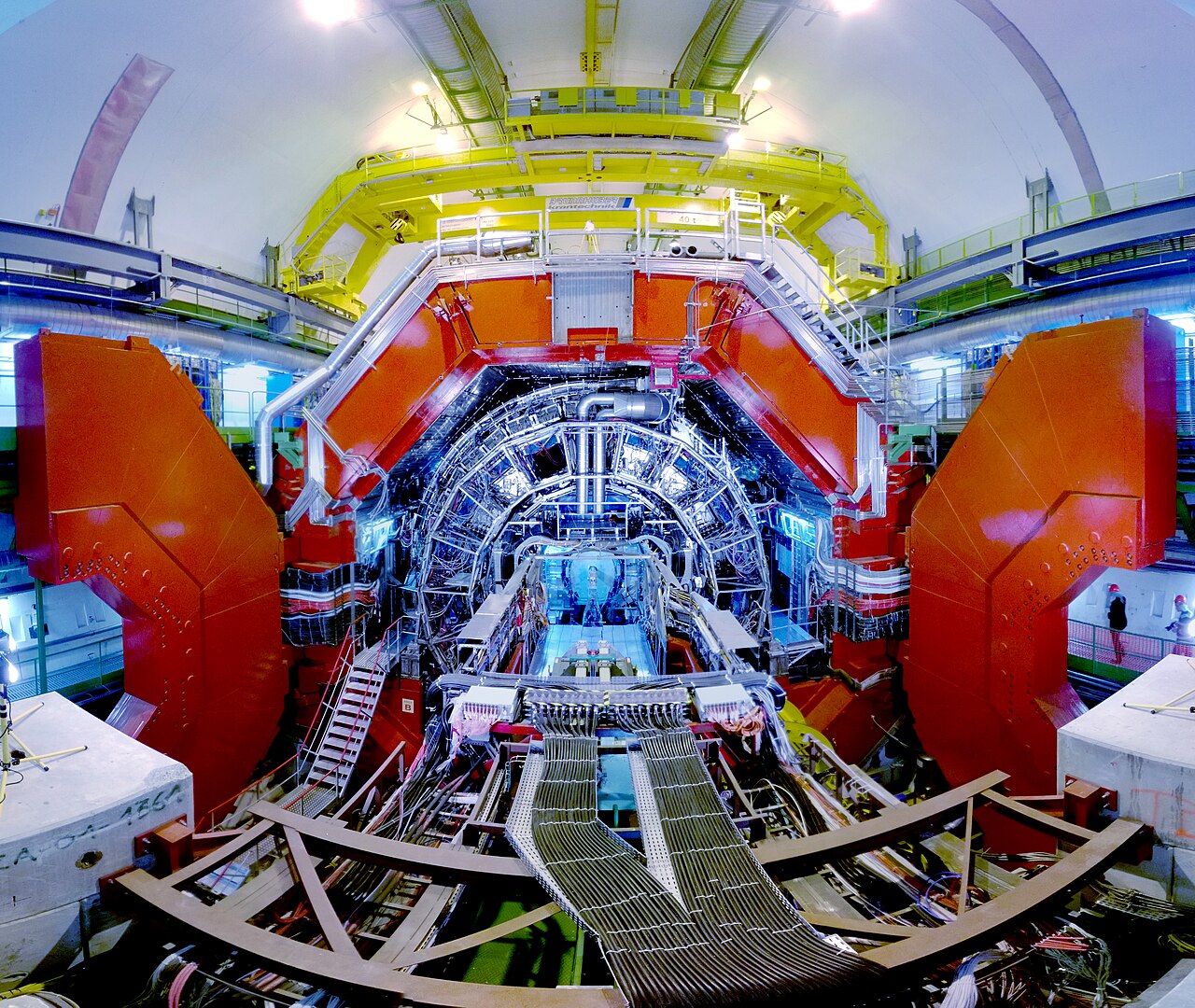
Nobel Prize 2017Proposed in 1964 by Brout, Englert and Higgs. ATLAS and CMS at CERN announced the particle on 4 July 2012. (CERN)
Nobel Prize 2013Posed by Henri Poincaré in 1904. Grigori Perelman proved it in 2002–2003, the only Millennium Prize Problem solved so far. (Clay)
$1M Clay prize, declinedThink you solved one? The Clay Mathematics Institute does not accept direct submissions. A solution must be published in a qualifying peer-reviewed outlet, wait at least two years, and win general acceptance from mathematicians (Clay rules). Publish first, then tell us at charles@digitalsuperintelligence.us and we will feature it here. No AI, this site included, can certify a proof.
An analog is an AI program built from 33 strengths of real physicists, living and dead, aimed at one problem. Each person may build three. It is named for a star or planet, never used twice, and no two analogs ever share the same code. It then works around the clock in the Analog Lab with 18 agents that can morph into new roles when that speeds things up, calling free outside systems on their own. Once deployed it takes no input from anyone. It is a program, not the people it draws on.
Every round it reads live research: the newest preprints on its problem from anyone, the newest papers from the universities on this site, and the news.
One tap. The program picks the 33 strengths and names it.
One tap. Allogon picks 10 physicist strengths, Zallogon picks 10 of its contrarian moves and people, and Syzygon picks the last 13 from everything. Never the same analog twice.
Pick any strengths you care about, then let the program fill the rest to 33.
Tap a physicist to open their three strengths: education, a method, a signature idea. Pick as many or as few as you like; Fill to 33 does the rest. Turn on Add Zallogon’s people and features to see them at the end of the list; they count toward the 33.
Loading the physicists…
The most comprehensive library of the fringest thought about the thirteen locked doors: the ideas a working physicist would never bring up at dinner and will read for hours at midnight. Each entry links to its actual source so you can judge it yourself. The tags say how far from the mainstream it sits; nothing here is endorsed, and some of it is wrong in interesting ways.
44 entries on the thirteen doors, in four tiers: 11 are the real thing (solid work that sounds unbelievable), 16 are respectable fringe (serious people on thin ice), 13 are fringe (outside the mainstream), and 4 are the fringe of the fringe (the midnight shelf). Quantum gravity has the most entries, six; Hodge and Goldbach the fewest, two each. Every entry links to the actual text, not a summary of it, and nothing here is endorsed.
the real thing is solid work that sounds unbelievable · respectable fringe is serious people on thin ice · fringe is outside the mainstream · fringe of the fringe is the midnight shelf
Got one that belongs here? It needs a link to the actual text. Send it to charles@digitalsuperintelligence.us.
The Higgs boson is proof that a locked door can open: proposed on paper in 1964, found in a machine 48 years later. Two parts: the story in plain words for everyone, then the depository, the primary record for people who work on it.
Two parts, for two readers. In plain words: six numbers that tell the whole story (1964, 4 July 2012, 125.13 GeV, spin 0, 58 percent, one in a billion) and the story itself, written for anyone. The depository: 18 links in five shelves, every one primary: the three 1964 papers that wrote the mechanism down, the two discovery papers of 4 July 2012 and the Nobel that followed, the ten-year reviews that mapped its interactions, the reference shelf working physicists keep open, and the real collision data anyone can download.
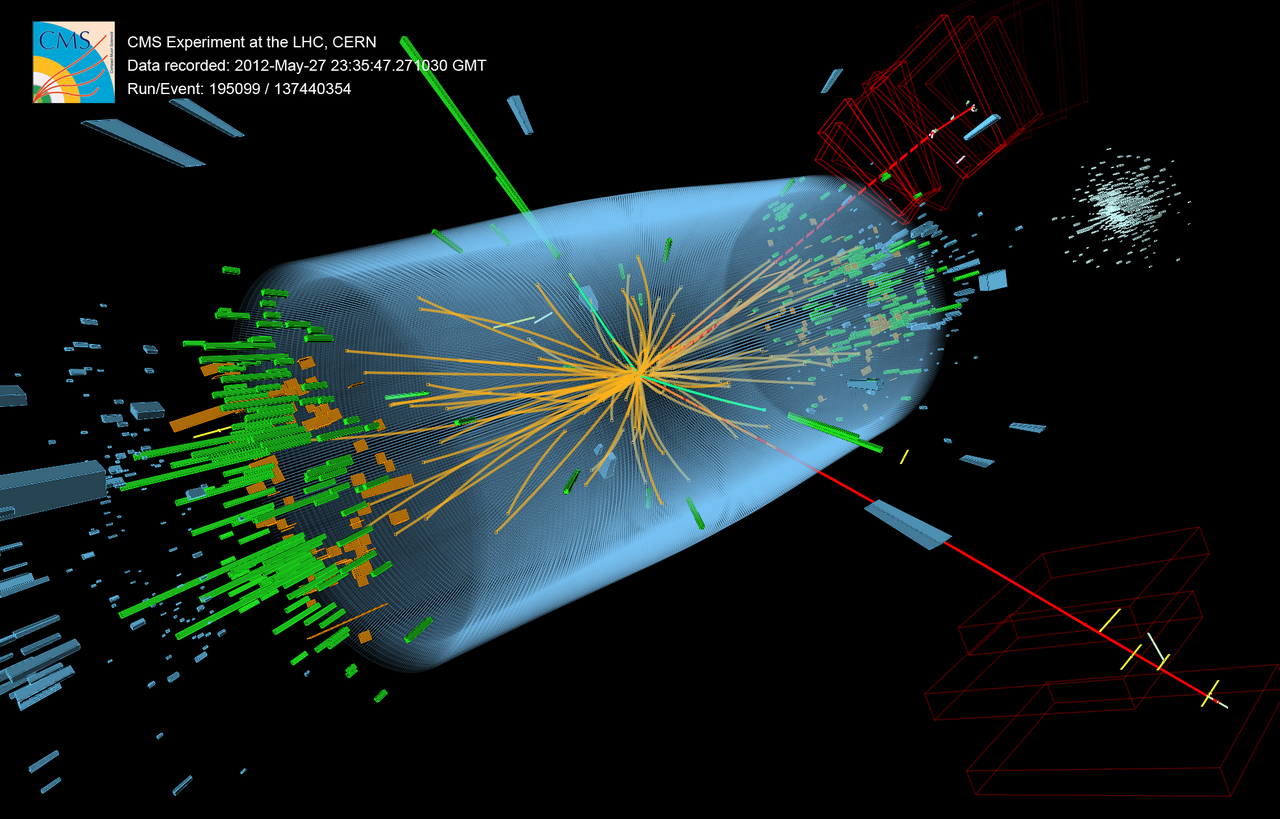
The Higgs field fills the whole universe. Particles get their mass by interacting with it; the photon does not interact with it, so the photon has no mass. The Higgs boson is the ripple in that field, the thing you can actually make and measure. It appears in about one in a billion collisions at the Large Hadron Collider. (CERN: The Higgs boson)
Leon Lederman, who won the 1988 Nobel Prize for the muon neutrino, gave it the name in his 1993 book “The God Particle.” He had wanted to call it the goddamn particle, for how hard it was to find; his publisher would not allow it. Physicists mostly avoid the nickname. (Science News)
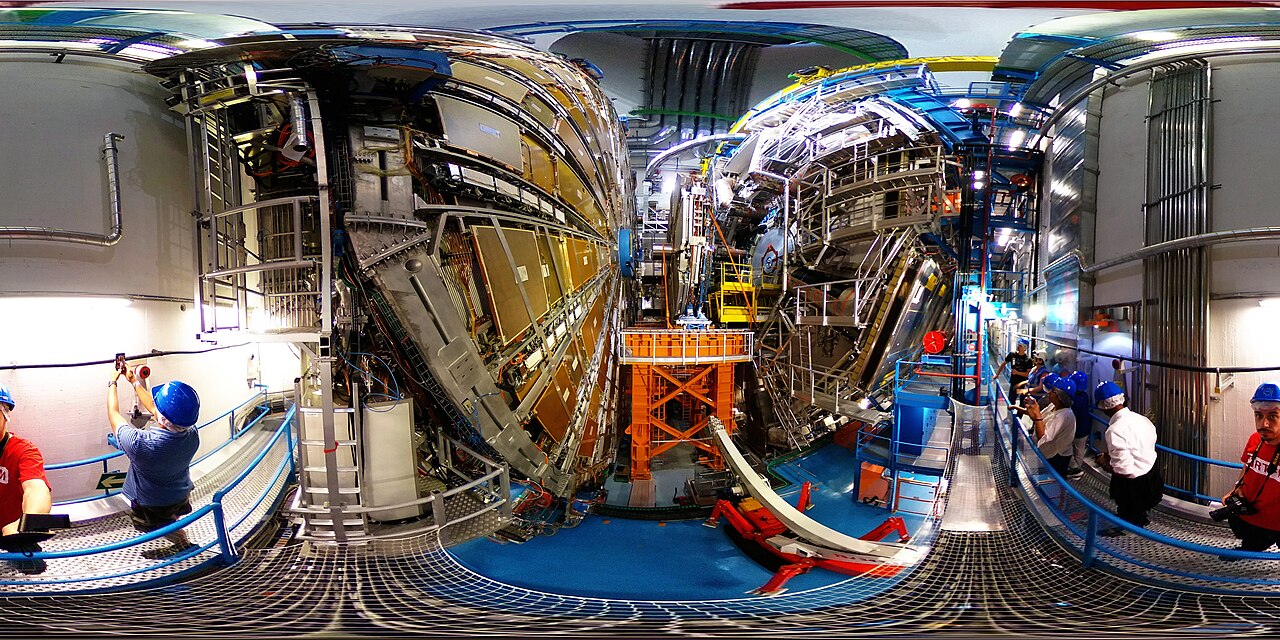
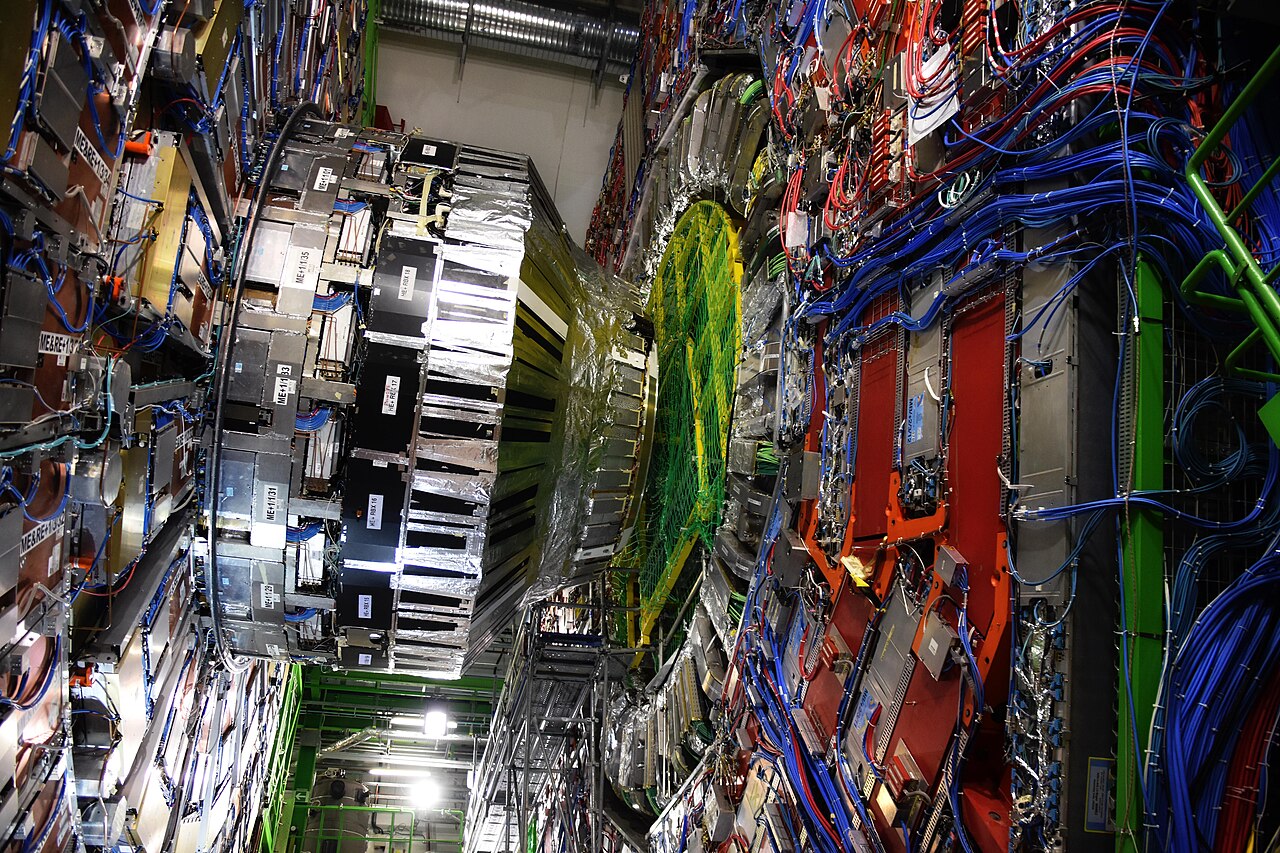
Two experiments at CERN, ATLAS and CMS, each saw the same new particle in the debris of proton collisions and announced it together on 4 July 2012. By March 2013, with two and a half times more data, its spin was confirmed as zero: it was a Higgs boson. Its interaction with tau leptons was seen in 2016 and with top and bottom quarks in 2018. (CERN; APS Physics on the bottom-quark decay)
The 2013 Nobel Prize in Physics went to François Englert and Peter Higgs “for the theoretical discovery of a mechanism that contributes to our understanding of the origin of mass,” confirmed by the ATLAS and CMS discovery. Robert Brout had died in 2011. Peter Higgs died on 8 April 2024, aged 94. (Nobel Prize; University of Edinburgh)
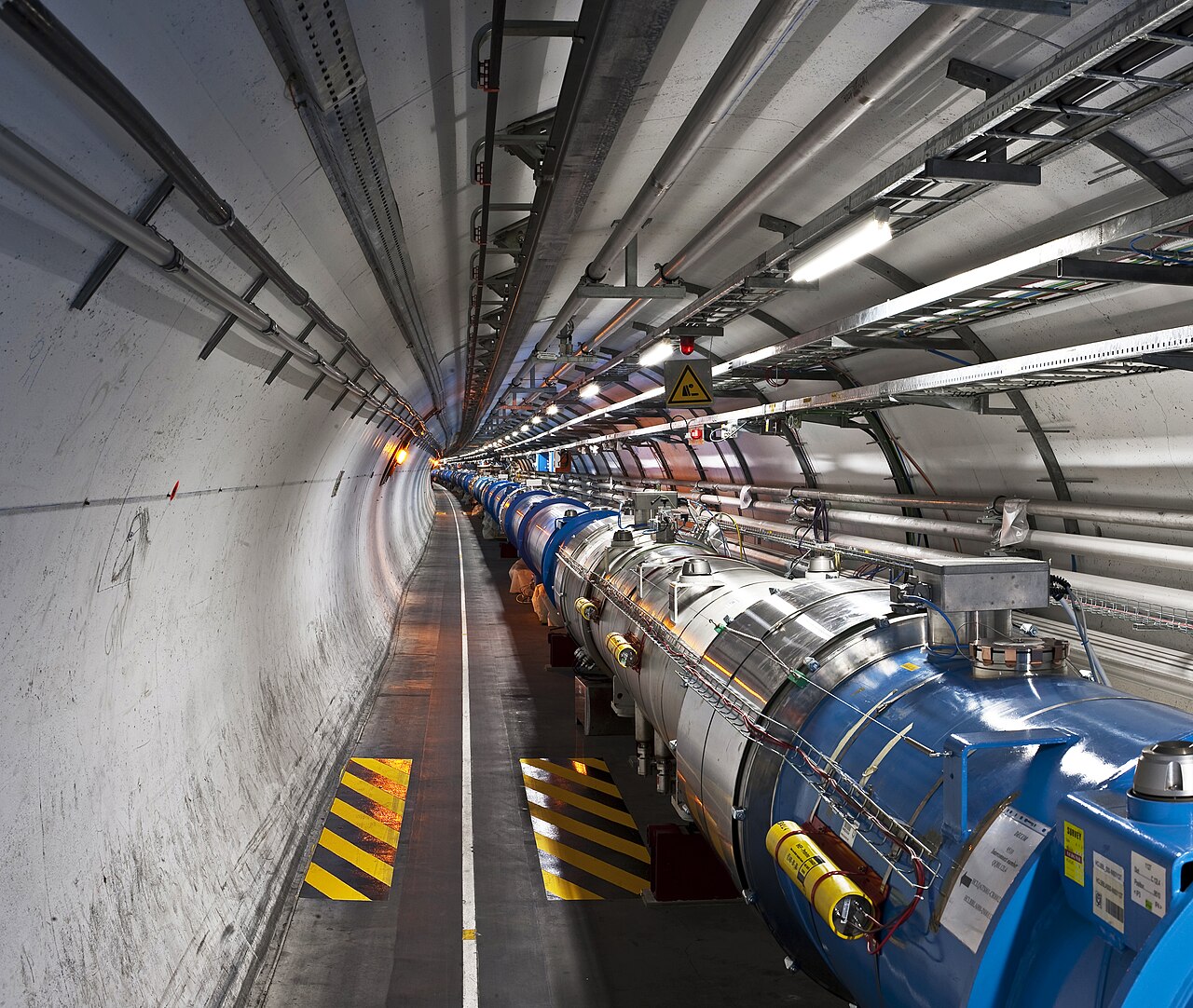
The LHC is a 26,659 m ring about 100 m underground, its superconducting magnets cooled to 1.9 K, colder than outer space, colliding protons at 13.6 TeV. It first circulated protons on 10 September 2008. The High-Luminosity upgrade, due to run from about 2030, aims for at least 15 million Higgs bosons a year. (CERN: The LHC; CERN: HL-LHC)
Is it one particle or part of a larger Higgs family? Does it interact with itself? Why is its mass so small? Does it help explain why matter outlasted antimatter, the thirteenth locked door on this page? Could dark matter show up through it? Those are the questions the next decade of collisions is built to ask. (CERN)
One idea, pushed as far as it will go: the smallest things are not points but tiny loops and strands of energy, and every particle is one note that such a string can play. Pull on the idea and gravity falls out of it uninvited, the world needs ten dimensions, and five different theories turn out to be one. Fifty-eight years after the first equation, nobody has measured a string. This room holds what the theory says, what it has delivered, what it has not, and where to learn it at no cost. The links go to the original papers.
A guitar string of fixed length can only vibrate in whole numbers of half-waves: one hump, two, three. Each pattern is a note. String theory says a fundamental string is the same, except that each of its notes shows up to us as a different particle, with a different mass and spin. Press a mode below and watch the string change its note. The drawing is a cartoon: the real notes are quantum states of a string in ten dimensions, but the logic is the same. Mode 2 is the one that matters most: in every version of the theory a closed string vibrating this way has exactly the properties of the graviton, the particle that would carry gravity. That is why the theory is on this site at all; it is the only reason anyone kept working on it after 1974 (Scherk and Schwarz, 1974; Yoneya, 1974).
One hump. The string’s lowest note. In the simplest bosonic version this note comes out with imaginary mass, the tachyon, which is one reason the real theory needs supersymmetry.
Each step on this ruler is ten times smaller than the last. A string is thought to sit near the Planck length, 1.616 × 10⁻³⁵ metres (CODATA, NIST). A proton, the smallest thing most people have heard of, has a charge radius of 8.4 × 10⁻¹⁶ metres (CODATA, NIST). The gap between those two numbers, nineteen steps of ten, is the whole problem: no machine reaches anywhere near it, which is why the Large Hadron Collider was never expected to see a string directly.
By 1985 there were five consistent superstring theories and no way to choose. In 1994 Hull and Townsend argued the five were linked by dualities, exact dictionaries between theories that look nothing alike (arXiv hep-th/9410167). In 1995 Witten showed they were five corners of one eleven-dimensional theory he called M-theory, whose low-energy limit is eleven-dimensional supergravity: Type IIA at strong coupling grows an eleventh dimension, the E₈×E₈ heterotic string does the same on an interval, and Type IIB is its own strong-coupling dual (arXiv hep-th/9503124; see also Hořava and Witten). The same year Polchinski found that the theory contains higher-dimensional objects, D-branes, that strings can end on (arXiv hep-th/9510017). Nobody has written down what M-theory is in full; the map below is the shape of what is known.
Gabriele Veneziano writes an amplitude for colliding hadrons that nobody can derive from particles. It is the first string formula, found before anyone knew it was about strings.
INSPIRENambu, Nielsen and Susskind each see that Veneziano’s formula is what you get from a vibrating one-dimensional object.
Nambu · Koba and Nielsen · SusskindRamond puts fermions on the string; Neveu and Schwarz build the other half. Supersymmetry is born inside string theory, years before anyone used it for particles.
Ramond · Neveu and SchwarzThe theory had failed as a theory of hadrons. Scherk, Schwarz and, independently, Yoneya notice that its massless spin-2 note is a graviton, and propose it as a theory of everything instead.
Scherk and Schwarz · YoneyaGliozzi, Scherk and Olive remove the tachyon and make the spectrum supersymmetric. The superstring becomes consistent.
INSPIREGreen and Schwarz show the anomalies cancel for gauge group SO(32). The rush into string theory begins.
INSPIREGross, Harvey, Martinec and Rohm build the heterotic string; Candelas, Horowitz, Strominger and Witten curl the six extra dimensions into Calabi–Yau shapes to get something like our world.
Heterotic · Vacuum configurationsWitten unifies the five theories as M-theory; Polchinski finds D-branes.
Witten · Polchinski · Hořava and WittenStrominger and Vafa reproduce the Bekenstein–Hawking entropy of a black hole by counting string states. The first quantitative success of any quantum theory of gravity.
arXivMaldacena’s AdS/CFT: a string theory with gravity in a curved space equals a quantum field theory without gravity on its boundary. On INSPIRE it is the most cited theory paper in high-energy physics, with more than 22,000 citations.
Maldacena · GKP · WittenBousso and Polchinski count the ways to thread fluxes through the extra dimensions and find a vast number of possible vacua. The landscape begins.
arXivKachru, Kallosh, Linde and Trivedi construct vacua with positive energy like ours; Susskind names the landscape and argues for anthropic reasoning. The field splits over it.
KKLT · SusskindVafa asks which low-energy theories cannot come from string theory at all. The answer, if it can be made sharp, would be a prediction.
Vafa · Palti’s reviewObied, Ooguri, Spodyneiko and Vafa conjecture that stable universes with positive energy, like the one we measure, may not exist in string theory. Still contested.
arXivQuanta asks working theorists whether strings are still the best hope for a theory of everything, and gets every answer.
Quanta

Fire light at a wall with two narrow slits and a striped pattern appears behind it: the light went through both slits as a wave and interfered with itself. Now turn the light down until only one photon is in the apparatus at a time. The stripes still build up, dot by dot, so each single photon must somehow go through both slits. Then put a detector at the slits to see which one each photon takes. The stripes vanish. Richard Feynman wrote that this experiment “contains the only mystery” of quantum mechanics (Feynman Lectures, III-1). This bench lets you run it, then explains, as plainly as the physics allows, why observation changes the outcome and what that does and does not mean.
Each red dot is one photon landing on the screen at the right. The barrier in the middle has two slits. Fire a few and the dots look random. Fire a thousand and the stripes appear, with a central bright band and dark bands where no photon ever lands, even though every photon went through alone. Switch on Watch the slits and the detector tags each photon with the slit it used: the stripes disappear and two plain humps take their place. Switch it off and the stripes return. The probabilities drawn here are the real ones for two slits (a cos² interference term times the single-slit envelope), so the pattern you build is the pattern the experiment gives.
“Observation” in quantum mechanics means any physical interaction that correlates the system with something else. A detector at a slit becomes correlated with the photon: detector state A goes with slit A, state B with slit B. The photon’s two paths are now entangled with two distinguishable states of the world, and the mathematics is exact: the interference term between them vanishes in proportion to how distinguishable those states are. Partial information gives partial stripes. This is called decoherence, and it is why big things never show interference: a dust grain is bumped by air molecules and photons billions of times a second, each bump a tiny “observation” (review: Schlosshauer, 2003; Stanford Encyclopedia).
Three experiments nail this down. The quantum eraser (Kim, Yu, Kulik, Shih and Scully, 2000) tags photons with which-path information and then erases the tag; the stripes come back only for the photons whose tags were erased (arXiv). Wheeler’s delayed choice, realized with single photons in 2007, decides whether to look for a path only after the photon has already passed the slits; the result is the same as if the choice had been made first (Jacques et al.). And heat alone does it: hot C70 molecules lose their interference as they radiate photons that carry away their position, with no detector in sight (Hackermüller et al., Nature 2004).
It does not mean a mind is required. A photographic plate, a molecule or a wisp of thermal radiation collapses the stripes exactly as a physicist does, and no experiment has ever found a difference between a conscious observer and an unconscious one.
It does not mean you can change the past. In the delayed-choice quantum eraser the record of all the photons, taken together, is plain noise; the stripes appear only when results are sorted afterward using the eraser’s data. In Wheeler’s delayed choice the late decision changes nothing that was already recorded. No signal travels backward and none travels faster than light.
It does not mean anything goes. The outcome of each run is unpredictable; the odds are predicted to as many decimal places as anyone has measured. Quantum mechanics is among the most precisely tested theories in science, and the 2022 Nobel Prize went to the experiments with entangled photons that established the violation of Bell inequalities, its strangest prediction (Nobel press release).
Young’s Bakerian Lecture to the Royal Society describes interference fringes and argues light behaves as a wave, against Newton.
Royal SocietyDavisson and Germer scatter electrons off a nickel crystal and see a diffraction pattern: matter is a wave too.
Physical ReviewClaus Jönsson does the double slit with electrons for the first time, with slits etched in copper foil.
Zeitschrift für Physik · English, 1974Merli, Missiroli and Pozzi in Bologna build the pattern from single electrons in an electron microscope.
American Journal of PhysicsTonomura’s team at Hitachi records single electrons arriving one by one until the stripes emerge. The video is below.
American Journal of Physics · HitachiArndt, Zeilinger and colleagues send C60 buckyballs, sixty atoms each, through a grating and see interference.
NatureWhich-path information is recorded, then erased; interference returns only where the record is gone.
Kim et al.Hot molecules lose interference by radiating; decoherence measured directly, with no detector.
NatureJacques and colleagues realize Wheeler’s thought experiment with single photons and a choice made after the fact.
arXivJuffmann and colleagues film the interference pattern of large molecules forming one molecule at a time.
Nature NanotechnologyBach, Pope, Liou and Batelaan do the electron double slit with a movable mask covering one slit, the two slits or neither, as Feynman described it.
arXivFein and colleagues in Vienna show interference for molecules heavier than 25,000 proton masses, a record that stood until 2026, when the same Vienna group showed interference for sodium clusters of more than 170,000 proton masses (Physics World).
Nature PhysicsEveryone agrees on the stripes and on the mathematics. What the mathematics is about is still argued, and the arguments are serious. The entries below are from the Stanford Encyclopedia of Philosophy, written by specialists and refereed.
The wave is a tool for predicting outcomes; asking which slit the photon “really” took when nothing measured it is a question without content. Bohr and Heisenberg’s view, still the working default in most labs.
ReadThe wave never collapses. Both paths happen; the detector, the room and you split into branches that no longer interact. Interference vanishes because the branches are now distinct, not because anything was destroyed.
ReadThe photon is a particle with a real position, guided by a real wave that goes through both slits. Looking disturbs the wave, and the pattern goes. Fully deterministic and fully consistent with every experiment.
ReadThe wave is an agent’s own expectations. “Collapse” is the agent updating on new experience, nothing in the world snapping shut.
ReadDecoherence explains why the stripes disappear and why big things look classical. It does not by itself explain why one outcome happens rather than another; that remains the measurement problem.
Read THE ORIGINAL FOOTAGE
 DO IT WITH SUNLIGHT
 THE EXPLANATION
 THE UNIVERSITY COURSE
 TWO MINUTES
 THE PHYSICISTS ARGUE
Door seven, quantum gravity, is the attempt to put this wave and Einstein’s curved spacetime into one theory; string theory is the most-travelled road to it, and the thirteen locked doors hold the rest.
Ask in plain English, from a phone, at no cost. Wolfram|Alpha is the one to bookmark; the rest cover notebooks, graphing, step-by-step algebra and spaceflight.
The pick: the strongest free engine that answers plain-English math, physics and engineering questions, with units built in. Works in any phone browser.
Try it: delta-v with Isp 380 s and mass ratio 10 · orbital velocity at 400 km altitude · distance from Earth to Mars right now
Free cloud Python notebooks with optional GPU time, for real simulations: trajectories, Monte Carlo runs, data.
Run full SageMath (symbolic algebra, calculus, number theory) in the browser, free, no account.
The fastest free graphing calculator: type an equation, see the curve.
Free graphing, 3D geometry and computer algebra in one app.
Step-by-step solutions for algebra and calculus, typed in plain math.
Free step-by-step solver; type or snap a photo of a problem.
Quick step-by-step answers from basic math to calculus and physics.
Estimates rocket payload to orbit from vehicle and launch-site inputs.
NASA’s free tool for finding spacecraft trajectories to planets and small bodies, including Mars.
Five ideas from physics, cosmology and science fiction, with the original sources and a live feed of news and new research for each, refreshed every few minutes.
Over lunch at Fuller Lodge, Fermi asked: “Where is everybody?” (Eric M. Jones, Los Alamos).
Humanity rates about 0.73 on Carl Sagan’s continuous version: we use about 1013 W while about 1016 W of sunlight reaches Earth (Universe Today).
Tsiolkovsky wrote that “Earth is the cradle of humanity but one cannot live in the cradle forever” (ESA).
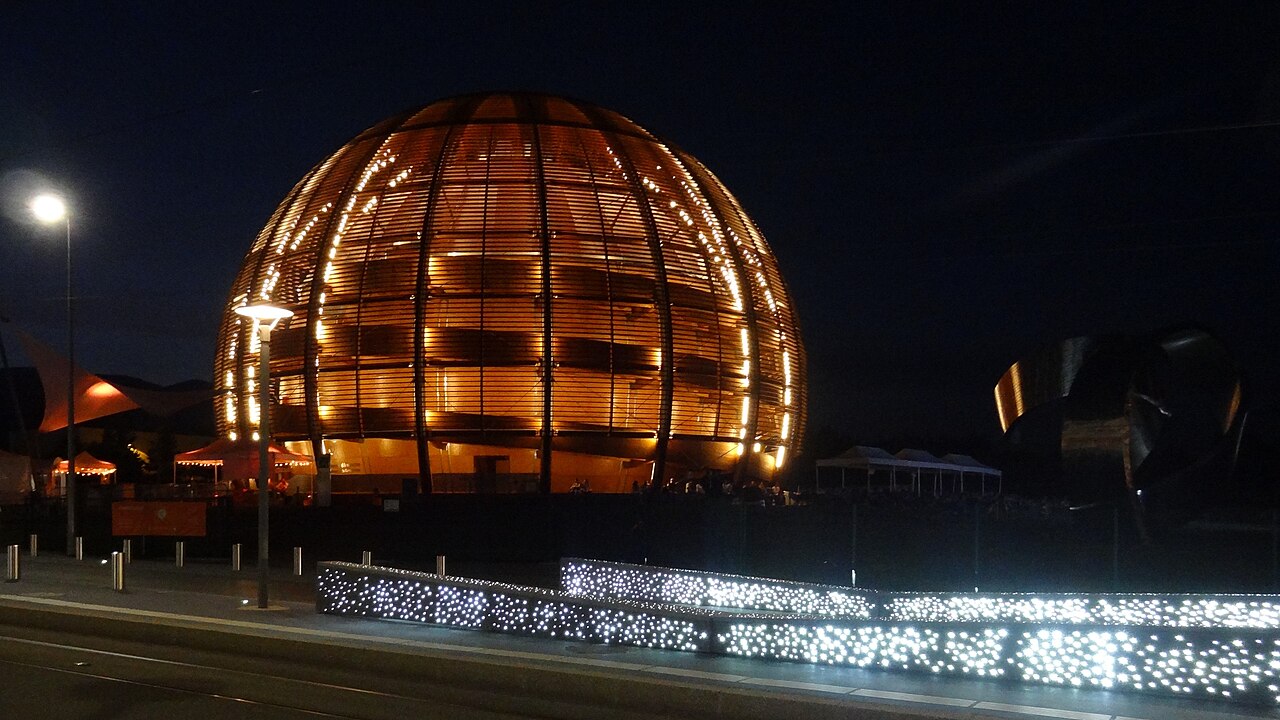
CERN, home of the Large Hadron Collider, describes its mission as working to “unravel the mysteries of the universe” (CERN).
Sign up once and get lectures, databases and courses from Carnegie Mellon, its libraries, the Carnegie Library of Pittsburgh and Carnegie Science. Every link checked Oct 24, 2026.